Release Early Release Often
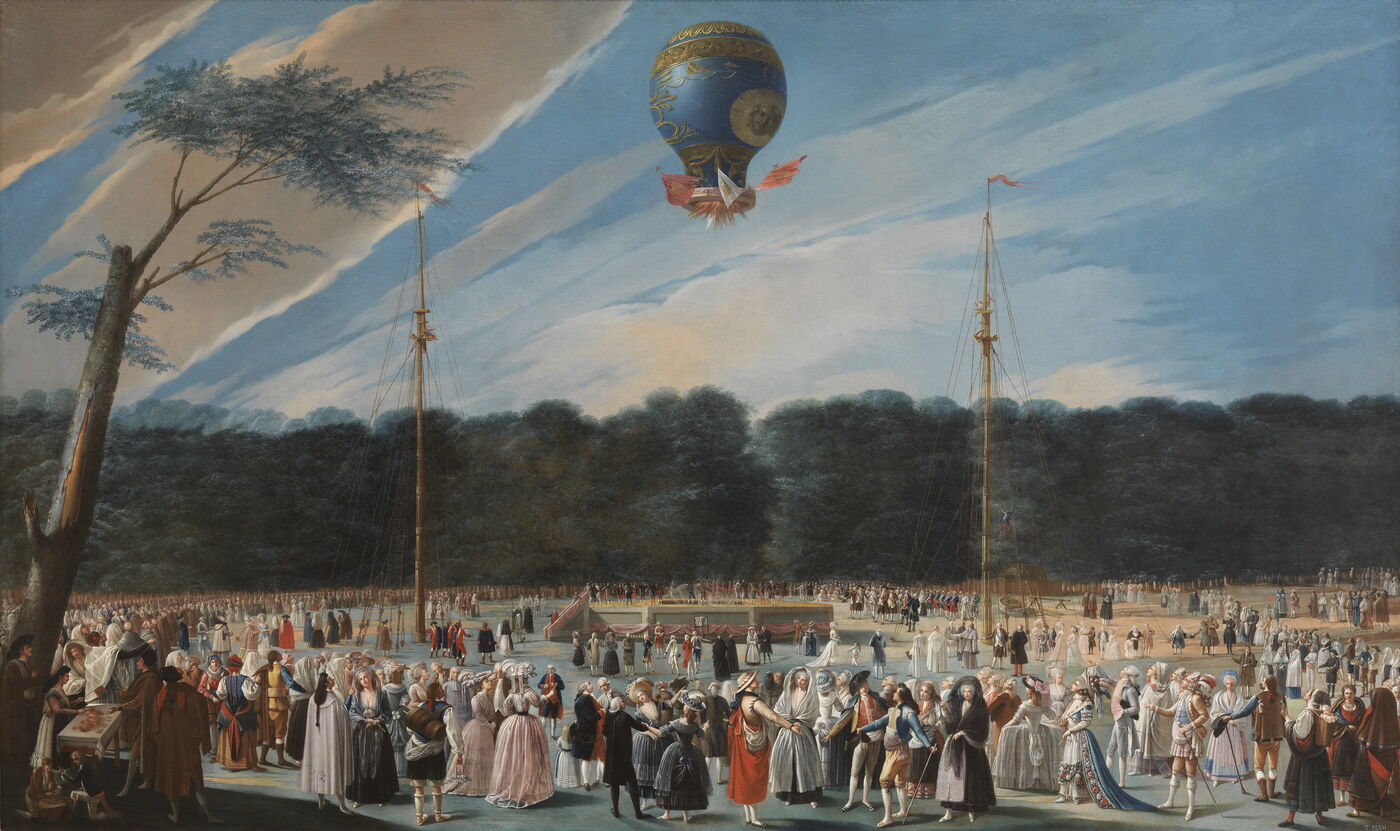
After Antonio Carnicero
Let go, then listen.
“What good is a newborn baby?” Benjamin Franklin, by Paris accounts, when asked what use a balloon was. August 1783.
June 1783. Nobody has ever flown. Fill the balloon, let it go before it’s perfect, and read what comes back.
Release early, release often
Every flight is a question.The landing is the answer.
Release early. Release often. And listen to your customers.Eric S. Raymond, The Cathedral and the Bazaar, 1997
Raymond was describing how Linux was built. Around 1991 Linus Torvalds sometimes released a new kernel more than once a day, and the people running it found the problems. A release is how you find out what you got wrong. Nothing you do before it can tell you.
Each flight teaches one thing
In the room, a flight that left the ground taught you one thing, whether it took ten days of work or sixty. Releases behave a lot like that. The feedback from each one is limited, so how fast you learn depends on how often you release, not on how much you put into each release.
Early isn’t broken
Let go before the balloon pulls and nothing flies, so nothing is learned. The usual criticism of releasing often is fair: ship carelessly and people stop trusting what you ship. Aim for the smallest thing that can fly, not the smallest thing you can push out the door.
The risks were real in 1783 too. Pilâtre de Rozier, the first person to fly, died in 1785 when his new balloon, hydrogen stacked over hot air, collapsed over the coast near Boulogne.
In software
- Send up the empty balloon. Put the smallest working version in front of someone before you build the oars.
- Fly the sheep first. The animals were a canary release: a small group that answers “can anything live up there?” before you risk people.
- Cut what the flights disprove. Oars, wings, rudders and a hand-cranked fan were all tried on balloons in 1784. None of them could push a balloon against the wind. On the first flight across the Channel, in 1785, Jean-Pierre Blanchard threw his overboard to stay in the air.
- Tell people what’s coming. When Charles’s hydrogen balloon came down at Gonesse in August 1783, villagers attacked it with stones, pitchforks and flails. A week later Paris printed a notice to the people: the globe was a machine that could do no harm. That was the first release note.
What happened
Joseph and Étienne Montgolfier were paper-makers from Annonay. In June 1783 they flew an unmanned balloon in public, sure that the fire made a special gas. It was the heat. They were wrong about why it worked and right to fly it anyway.
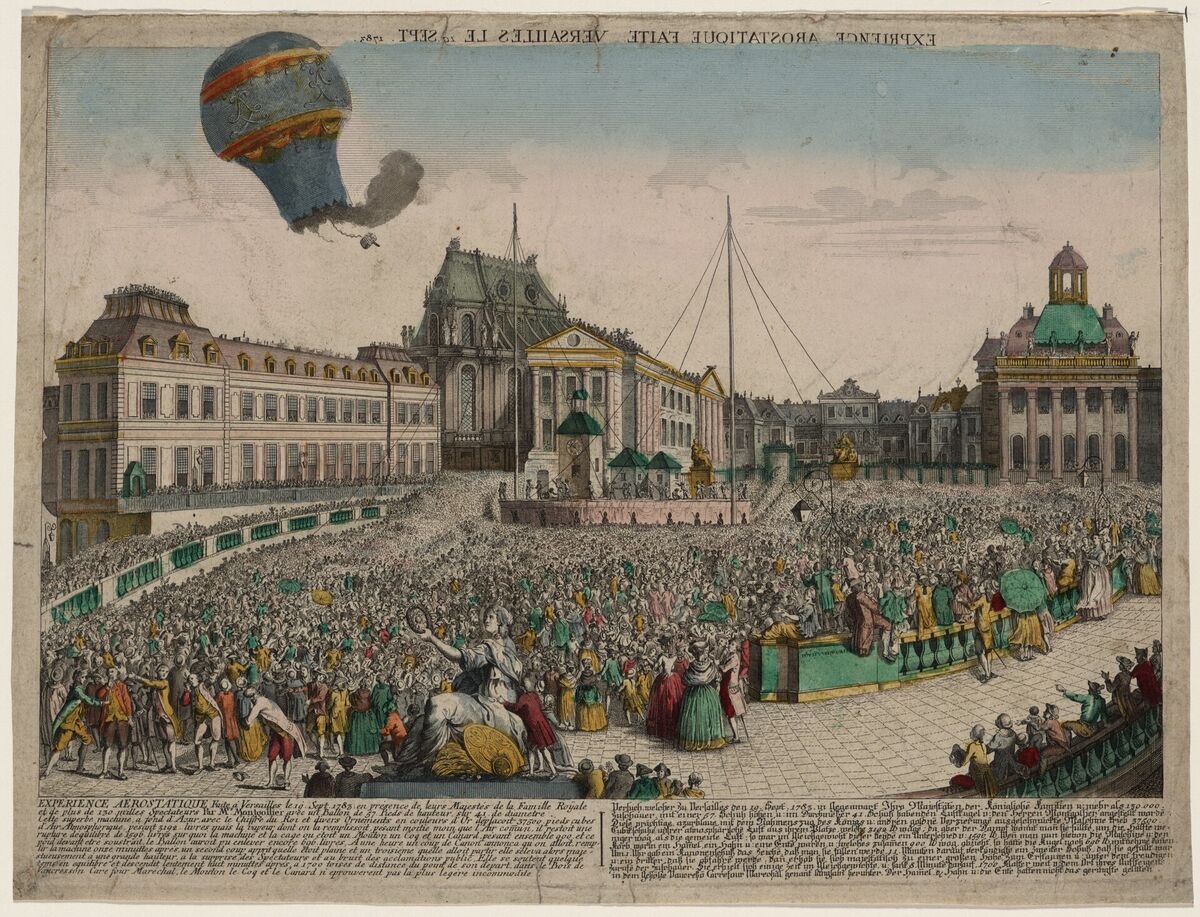
When wind and rain wrecked their Paris balloon on September 12, they built another in five days. On September 19 it carried a sheep, a duck and a rooster at Versailles; the rooster’s sore wing came from the sheep, before take-off. On November 21 Pilâtre de Rozier and the marquis d’Arlandes flew across Paris for twenty-odd minutes, and d’Arlandes put out the burning holes with a wet sponge. Ten days later the physicist Jacques Charles and one of the Robert brothers flew a hydrogen balloon from the Tuileries for two hours.
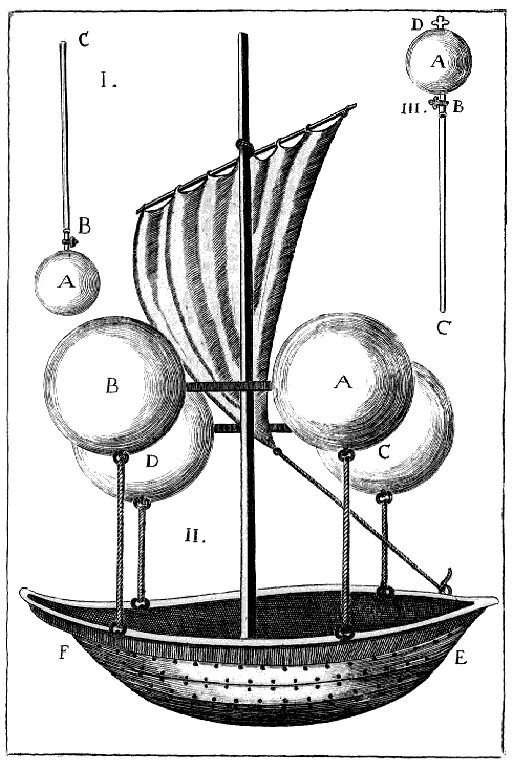
In 1670, more than a century earlier, the Jesuit Francesco Lana de Terzi had published a flying boat lifted by four copper spheres with the air pumped out. He saw that the air might crush them, argued the problem away, and never built it: his vow of poverty kept him from spending the hundred ducats.
The game simplifies 1783. The letters, fixes and day counts are ours. Franklin’s line about the newborn baby is how Paris remembered his answer; he never wrote it down. The painting shows a later launch, by a Frenchman named Bouclé at Aranjuez on June 5, 1784.